Get Free Ebook Reinventing Fire: Bold Business Solutions for the New Energy Era
You could gain the book by checking out to the web link web page of guide. It will certainly not be understood when you don't download the application. And then, you could save it to the tool. You understand, as the created and also advanced innovation in these recent years, the tasks and all things can be done by applying or utilizing the technology. This is as just what to do to obtain Reinventing Fire: Bold Business Solutions For The New Energy Era in the soft file. You have to link to the internet as a typical thing today.
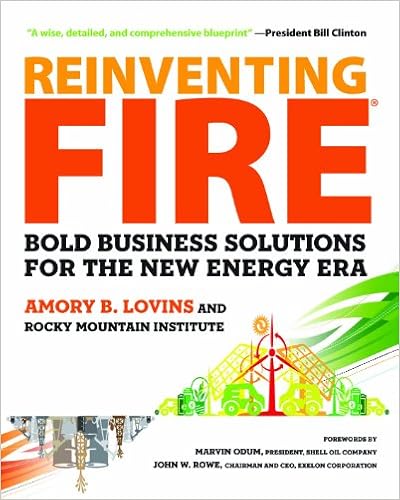
Reinventing Fire: Bold Business Solutions for the New Energy Era

Get Free Ebook Reinventing Fire: Bold Business Solutions for the New Energy Era
Find your own means to meet your spare time. Taking into consideration reviewing a publication as one of the activities to do in leisure could be proper. Reading a book is valuable as well as it will worry about the brand-new things. Reviewing, as thought about as the uninteresting activity, may not rally be as exactly what you consider. Yeah, analysis can be enjoyable, analysis can be enjoyable, and reading will offer you new things, even more points.
When you have had this publication, it's very adorable. When you want this publication as well as still plan, don't bother, we offer below specifically for you. So, you will not lack Reinventing Fire: Bold Business Solutions For The New Energy Era when in the store. Guide that exists is in fact the soft data. As the internet collection, we show you many types and also collections of books, in soft documents forms. However, it can be gotten sensibly and easily by visiting the link supplied in every web page of this internet site.
Obtaining the competed material of the book even in the soft file is truly remarkable. You could see exactly how the Reinventing Fire: Bold Business Solutions For The New Energy Era is presented. Before you obtain the book, you may not know concerning exactly what guide is. But, for more feasible thing, we will certainly share you little concerning this publication. This is the book to suggest that gives you a good idea to do. It is likewise presented in extremely fascinating referral, instance, and also explanation.
When you are assuming that this publication is also ideal for you, you should establish the moment when you want to start analysis. In making the principle of the analysis publication, this publication can be starter indicate lead you liking a book, not just to present however likewise to review. Currently, aim to understand it and let your friends and family learn about this publication and website. You could educate to them that this website actually provides billion titles of publications to read. So, gather and also obtain the features.
Review
Book News- Author Lovins, a government consultant on energy, is co-founder and chief scientist of Rocky Mountain Institute, an independent think-tank on the use of natural resources. In this color illustrated book for business leaders and others, Lovins predicts that if businesses start now to adopt currently available alternative energy technologies at normal rates of return, the US can realistically stop using oil and coal by 2050, for a savings of $5 trillion. The author argues that because the necessary legislation and public policy are already in place for the transition to clean power, the transition can come about through market-based innovation across many different industries. After explaining the true costs of oil and coal, the book focuses on transportation, building design, improvements in industry energy efficiency, and carbon-free electricity generation. The book's reader-friendly layout includes color photos, charts, and case and example boxes on every page, combined with an accessible writing style. While the contributors are all affiliated with Rocky Mountain Institute, the book's content has been reviewed by outside experts as well. A web site offers supporting methodological and technical material.Choice- Energy forms the basis of modern living and is tied to every country's economic, political, social, health, and environmental policies. This well-documented work by energy expert Lovins (cofounder, Rocky Mountain Institute) and RMI staff begins by discussing the growing economic and environmental impact of fossil fuel dependence. Next, separate chapters address four different energy-intensive sectors in the US: transportation, buildings, industry, and electricity. Each chapter includes data on current energy consumption along with ways to change existing patterns (e.g., new designs, renewable sources, more-efficient practices). The concluding chapter ‘Many Choices, One Future,’ looks at the US in 2050: shortened workdays, decreased road traffic, a cleaner atmosphere, and a huge amount of capital formerly wasted on fossil fuels available to address various social challenges. This assumes that the path charted in ‘Reinventing Fire’ is at work. The authors argue that their proposal is economically feasible and would create jobs, positively impact the environment, and enhance the global competitiveness of the US. Among the barriers listed, the resistance of political incumbents and an absence of visionary political leaders committed to these fundamental changes stand out. A must read for anyone who deals with energy, especially decision makers. Summing up: Highly recommended. Upper-division undergraduates through professionals; general readers.ForeWord Reviews- Reinventing Fire is an engaging and comprehensive introduction to the issues and challenges tied to our nation's energy use. Amory Lovins is a noted authority on energy―especially its efficient use and sustainable supply. In 2009, Time named him among the world's 100 most influential people, and Foreign Policy, one of the 100 top global thinkers. In 1982, Lovins co-founded the Rocky Mountain Institute (RMI), an independent, nonprofit think tank focused on the ‘efficient and restorative use of resources.’ The team's expertise is evident, as Lovins and fellow RMI researchers outline the current state of energy use, including what they call the nation's "addiction to fossil fuels," and propose an array of transformational solutions. Their long-term view emphasizes smart business strategy over public policy as the route to the ‘new energy era.’ The ‘winners’ in this new era will be those companies, organizations―and even nations―nimble and innovative enough to anticipate and realize the opportunities. Following a review of our energy profile today, the book sets the stage with two contrasting scenarios for energy consumption in 2050, one that is ‘business as usual’ and one that ‘reinvents fire.’ The optimal scenario would reduce overall energy consumption through innovation and efficiency, while increasing use of renewable sources and bringing a multitude of benefits―to the economy and the environment, as well as to our health and national security. The challenges posed by this book are at once inspirational and daunting, but Reinventing Fire makes it clear that facing them with passion and ingenuity is essential to our future prosperity as a people and a nation."Amory and his 'reinventing fire' energy path should be part of the induction packs for all political, financial and business leaders."--John Elkington, The GuardianReinventing Fire shows us that we neither need to freeze in the dark, nor go back to the Stone Age, to ensure a healthy, habitable planet for ourselves and our descendants.--Andy Kerr, Home Power "In crisp and vivid language, Amory Lovins sets out a blueprint for a much-improved future in the generation and use of energy. We can all learn from reading this clear statement from a real expert."--George P. Shultz, former Secretary of State and Secretary of the Treasury, distinguished fellow at Stanford University's Hoover Institution, former president of Bechtel"My friend Amory Lovins knows that the most important question of the twenty-first century is the 'how' question-how we turn good ideas into working solutions. Reinventing Fire is a wise, detailed, and comprehensive blueprint for gathering the best existing technologies for energy use and putting them to work right now to create jobs, end our dependence on climate-changing fossil fuels, and unleash the enormous economic potential of the coming energy revolution."--President Bill Clinton"If you wanted to bring America happiness and prosperity, and address unemployment, government gridlock and climate change, and create meaning in a world rife with contradictory views and ideologies, you can do one thing: read Reinventing Fire...and then see to it that it is read by every decision maker in the land. This is a stunning work of enormous dimension. Reinventing Fire outlines an eminently practical path to a durable and meaningful future by reimagining how we use and produce the lifeblood of civilization-energy in its myriad forms."--Paul Hawken, author of Blessed Unrest; co-author, Natural Capitalism"Amory Lovins and his team of extraordinary professionals provide an analytically sound, detailed, compelling plan for transforming our national use of energy-and for saving $5 trillion in the process! Reinventing Fire is a towering work, a page-turning tour de force of compelling wisdom that deserves a permanent place on the desk-nay, in the mind-of whoever holds the chair in the Oval Office."--Robert C. McFarlane, national security advisor to President Reagan; co-founder and co-chair of the United States Energy Security Council"America's business leaders have long waited for a practical vision of how innovation and entrepreneurship can drive the shift from fossil fuels to efficiency and renewables. Now, in Reinventing Fire, that profit-led path is here, clear, and compelling."--Gerald D. Hines, founder and chairman, Hines
Read more
About the Author
Amory Lovins, a consultant physicist, is among the world's leading experts in energy and its links with resources, security, development, and environment. He has advised the energy and other industries for four decades as well as the U.S. Departments of Energy and Defense. His work in 50+ countries has been recognized by the "Alternative Nobel," Blue Planet, Volvo, Zayed Future Energy (Runner-Up), Onassis, Nissan, Shingo, Goff Smith, and Mitchell Prizes, the Benjamin Franklin and Happold Medals, MacArthur and Ashoka Fellowships, 11 honorary doctorates, honorary membership of the American Institute of Architects, Foreign Membership of the Royal Swedish Academy of Engineering Sciences, honorary Senior Fellowship of the Design Futures Council, and the Heinz, Lindbergh, Jean Meyer, Time Hero for the Planet, Time International Hero of the Environment, Popular Mechanics Breakthrough Leadership, National Design, and World Technology Awards. A Harvard and Oxford dropout and former Oxford don, he has briefed 20 heads of state and advises major firms and governments worldwide, recently including the leadership of Coca-Cola, Deutsche Bank, Ford, Holcim, Interface, and Wal-Mart. He cofounded in 1982 and serves as Chairman and Chief Scientist of Rocky Mountain Institute, an independent, market-oriented, entrepreneurial, nonprofit, nonpartisan think-and-do tank that creates abundance by design. His most recent visiting academic chair was in spring 2007 as MAP/Ming Professor in Stanford's School of Engineering, offering the University's first course on advanced energy efficiency (www.rmi.org/stanford). The latest of his 30 books is Reinventing Fire: Bold Business Solutions for the New Energy Era. An anthology from his 1968-2010 work, The Essential Amory Lovins, was released in 2011. He is also the co-author of the sustainable business classic, Natural Capitalism. In 2009, Time named him one of the 100 most influential people in the world, and Foreign Policy, one of the 100 top global thinkers.
Read more
Product details
Hardcover: 352 pages
Publisher: Chelsea Green Publishing; 1 edition (October 15, 2011)
Language: English
ISBN-10: 1603583718
ISBN-13: 978-1603583718
Product Dimensions:
7.5 x 1.2 x 9.2 inches
Shipping Weight: 2.6 pounds (View shipping rates and policies)
Average Customer Review:
4.6 out of 5 stars
75 customer reviews
Amazon Best Sellers Rank:
#172,176 in Books (See Top 100 in Books)
For those of us who have followed Amory Lovins career, this book should be the overview of years of research on the shift to a sustainable society. It is partly that, but also a long-winded pep-talk that the transition is immenently possible in the constraints of our for-profit economic system. The book's centerpiece is the vision at the beginning of Chapter 6 of society in 2050 in which cars are vastly lighter and more efficient, though even more peppy and fun, production processes are close to their theoretical efficiency limits thanks to innovation, food is locally grown, people live much closer to their work, the electrical grid is decentralized and more reliable, and so on, all because it costs less this way than the world we live in today. Lovely, but everyone reading the book who is aware of Amory Lovins' 40-year career on promoting these ideas can and should ask, if it is vision is realistica, why has it not happened?The answer is not necessarily found in the book. While it abounds with success stories of people making money off of increased efficiency through introduction of currently available technologies, integrative design of buildings, rethinking of transport, and decentralization of the power grid, one cannot avoid the suspicion that these are but exceptions to the rule of our resource- and energy-intensive society. Of course, real evidence of a genuine transition can be found in some of the ~800 citations, particularly those pointing to RMI publications over the years. Thus, the reader who looks for objective view should consider this book as a starting point for extensive reading of informative (but admittedly dry) scientific articles.Lovins owes us a more introspective analysis on why this transition has not been a no-brainer and is not now in full swing. The authors have intersperse comments about this, as well as a section on "Barriers to Reinventing Fire". Rightly so, but they would better serve their cause by writing a chapter, or better yet a full book, on these counteracting these hurdles. Consider some simple questions: o Of course there is intense passive and active resistance by actors with vested interests. How do humankind build up a critical mass of endorsement of the vision which overcomes it? o Naturally businessmen and politicians take the short-term view for quarterly profits or the next election. How to we redirect our society to demand long-term profits and leadership? o Currently, China spends about 6.5% of GDP on combatting the effects of pollution on public health (source: Rand Corporation). And despite this it is difficult for leaders to quantify the benefits of better health and education. How do we give value to these 'intangibles'? o Many, many people would like to believe the vision, in particular the idea that the same or better quality of life can be far less damaging to the environment. But we today we are faced with consumer choices which are still carbon-intensive. How on earth is it possible to acquire more efficient options, while still enjoying the same level of mobility, life quality, and recreation, without somehow introducting a carbon tax? o And many of those people would like to join this efficiency revolution -- which requires expertise across the spectrum -- but we are constrained by simple realities of having to provide for your families. Where are the jobs in this multi-trillion dollar economy?"Reinventing Fire" is still a good compendium of years of research by the RMI, and makes valid arguments that there can be viable business solutions for a energy-frugal society. While the authors make it plausible, they are not still are not able to paint the path to overcome our own inertia.
I was reluctant to order the Kindle edition as a reviewer had suggested is was "unreadable". That problem apparently has been solved as of December 2015. It reads perfectly on my standard Kindle. The sidebars have a colored background. It's easily legible, at standard or slightly larger type fonts and with a black, sepia or white background. This is a very large book, the kindle edition makes a great deal of practical sense and is a bargain. Do NOT, repeat, do NOT hesitate to purchase the kindle edition. As far as the content goes...Dr. Lovins has the sharpest critical analysis of this issue, the central one affecting our planet, completely data based, exhaustively researched, and his message is simple. Politics won't solve our problem, capitalism just might. Put a profit margin in the problem and stand back, engineers and businessmen from around the world will attack it without mercy, and the winners will make a fortune.
The book is not perfect, but its scale and the amount of work that went into it is incredible. There are over 750 references and the bibliography represents a lifetime of energy reading and research.The book provides an optimist's vision of American and global energy generation and energy efficiency strategies leading to an ideal mix by 2050. Lovins lays out the big picture of how this is possible, economically advantageous, and even probable. Best of all, Lovins stays apolitical - my favorite quote is "we just need to stop insisting that others embrace our differing why and together get on with doing the shared what." He stays positive throughout and insists that reducing CO2 emissions (through efficiency and smarter fuels/grids) and increasing the use of renewables is good business for America and the developing world. I hope he's right.Lovins picks winners though, he clearly is not a believer in nuclear power's usefulness and lays out a compelling case for his position. He also incorporates biofuels into his vision without making a solid case for how. Lovins also takes some creative liberties in applying the costs of hidden subsidies to fossil fuels - suggesting that the entire bill for CENTCOM and all conflicts in the Middle East should be added to the price of oil.The book is sometimes hard to follow with sidebars and graphics interrupting the flow. There's also a fair amount of redundancy - some of the graphics make multiple appearances and Lovins tend to drive an idea home by repeating it over and over again. I found myself zoning out and having to repeat sections often.Overall it's an incredible book, I would recommend it to anyone interested in the future of energy.
Reinventing Fire: Bold Business Solutions for the New Energy Era PDF
Reinventing Fire: Bold Business Solutions for the New Energy Era EPub
Reinventing Fire: Bold Business Solutions for the New Energy Era Doc
Reinventing Fire: Bold Business Solutions for the New Energy Era iBooks
Reinventing Fire: Bold Business Solutions for the New Energy Era rtf
Reinventing Fire: Bold Business Solutions for the New Energy Era Mobipocket
Reinventing Fire: Bold Business Solutions for the New Energy Era Kindle
Post a Comment